About REFUGIN
Work packages

WP1
Project Management
Leader : Association les Militants des Savoirs (The Conveyors of Knowledge)

- Administration & financial management
- Communication & dissemination
- Monitoring & Evaluation : quality monitoring and Evaluation Plan
- Consortium meetings
WP2
Network and Mapping promising practices
Leader : KMOP - Social Action and Innovation Centre

- European network of civil society professionals
- Mapping promising practices
- International Civic Form Practical Manual
The REFUGIN project launched a European network of practitioners to enhance collaboration between professionals working with young refugees and people in refugee-like situations.
Developed by IPS Innovative Prison Systems, the REFUGIN Network connects NGOs, educators, researchers, and public institutions to share tools, resources, and innovative practices.
The platform includes:
A members directory with over 90 active members from 12 countries,
A library of 130 open-access resources covering 43 thematic areas,
Interactive forums, events, and a training materials section,
A multilingual environment supporting inclusion and collaboration.
🌱 Sustainability and Future Outlook
The REFUGIN Network will remain active for at least three years beyond the project’s end, continuing to promote cross-sector cooperation and shared learning.
A sustainability plan ensures ongoing activities ; updated training resources, regular events, and continuous engagement between members.
By fostering mutual understanding and collaboration, the network leaves a lasting legacy of inclusion, solidarity, and professional empowerment across Europe.
📄 Please consult the full document to learn more about the WP2 results and the creation of the REFUGIN Network
‘’Creating of an online practitioners network’’ Report
Are you working with young refugees? Join our growing community of dedicated professionals who are making a real difference in refugee integration.
📖 REFUGIN Good Practices Manual
Proven Strategies for Young Refugee Integration
Europe's First Comprehensive Guide
Our Manual of Good Practices compiles the most effective integration strategies from across 8 European countries. Based on real experiences and proven results.
What's Inside
✅ Community mentorship programs with 70% success rates
✅ Digital literacy initiatives accelerating integration
✅ Cultural mediation strategies bridging language gaps
✅ Holistic support models covering education, housing & employment
Our Good Practices Manual for young refugee integration is now available in all partner country languages:
Available Versions
🇫🇷 French | Télécharger ici le Manuel de bonnes pratiques
🇬🇧 English | Download here the Manual of Good Practices
🇬🇷 Greek | Κατεβάστε εδώ το Εγχειρίδιο Καλών Πρακτικών
🇵🇹 Portuguese | Baixe aqui o Manual de Boas Práticas
🇵🇱 Polish | Pobierz podręcznik najlepszych praktyk
🇷🇴 Romanian | Descărcați aici Manualul de bune practici
🇷🇸 Serbian | Priručnik dobrih praksi“
📘 Manual of Good Practices – Insights on Refugee Integration
The Manual of Good Practices presents the findings of a comprehensive literature review and an online survey conducted in all partner countries of the REFUGIN project.
It provides an overview of the main challenges, lessons learned, and innovative approaches to support the integration of young refugees and people in refugee-like situations across Europe.
🌍 Main Findings
Holistic approach:
The successful integration of refugees and migrants requires a comprehensive and coordinated strategy, addressing the full complexity of their living conditions.
Interconnected domains:
Key areas such as employment, education, housing, and health are closely linked and mutually influence each other.
Multiple dimensions:
Effective integration depends on attention to the economic, social, cultural, legal, and political aspects of refugees’ and migrants’ lives.
Practical recommendations:
The manual offers concrete guidance for educators, NGOs, and policymakers, suggesting actionable ways to improve the inclusion of young refugees in these domains.
Understanding the Field
As part of Work Package 2 (Creating REFUGIN’s Network and Mapping Promising Practices), an online survey was carried out among educators and NGO professionals working with young refugees across France, Greece, Hungary, Moldova, Poland, Portugal, Romania, and Serbia.
The objective was to gather insights into:
Existing promising practices for refugee and youth integration;
Challenges and barriers faced by practitioners in their daily work;
Needs and recommendations for improving support mechanisms and collaboration.
Key Findings
Respondents highlighted that most of their work focuses on:
Educational, linguistic, and cultural inclusion of young refugees;
Building social connections between refugee and host communities;
Creating safe and stable environments for integration.
Among the most effective practices, the survey identified:
Mentoring and peer-to-peer support networks;
Language and cultural orientation courses;
Psychosocial and mental health support initiatives;
Community events fostering intercultural dialogue and inclusion.
Barriers most frequently mentioned by respondents included:
Limited funding and resources;
Legal and administrative obstacles;
Language barriers and communication challenges;
Discrimination and lack of intercultural training for professionals.
🌱 Recommendations
Survey participants underlined several key factors for successful integration:
Access to education, legal rights, and public services;
Language learning opportunities for both youth and adults;
Strengthening NGO cooperation with local authorities and communities;
Promoting mentoring programmes and social inclusion initiatives.
They also stressed the importance of capacity-building activities such as workshops and training on intercultural awareness, conflict resolution, and multisectoral cooperation.
📚 Mapping Promising Practices
The survey helped identify a wide range of inspiring initiatives in partner countries, covering domains such as education, psychosocial support, community events, and civic participation.
WP3
Needs Assessment
Leader : Easi - European Association For Social Innovation

- Assessing Refugee’s needs: Survey & Focus groups
- Assessing professionals’ needs: Survey @ Focus group (public target: International Panel)
Objective
The WP3 aims to identify precisely the current needs of young refugees in Europe, as well as those of the education professionals and NGOs who support them. The direct involvement of these groups is essential in order to produce reliable and actionable information.
Our methodological approach
A mixed quantitative and qualitative approach deployed in all partner countries :
- Surveys to provide an overview;
- Interviews to explore needs and practices in greater depth;
And focus groups to identify shared priorities and realistic solutions.
What WP3 will produce :
- A map of the needs of young refugees and practitioners;
- An assessment of the situation experienced by young people (realities, obstacles, levers);
- Operational lessons to guide the rest of the project.
Coordination with other WPs.
The results of WP3 will guide the design of training courses (WP4) so that they meet the real needs of the direct (young people) and indirect (professionals) audiences.
They will inform mentoring and inclusion frameworks (WP5) for tailor-made and more effective measures.
WP3 builds on the findings of WP2 (role of professionals and overview of practices), which have already been incorporated as a starting point.
Purpose
To place needs on the ground at the heart of the project in order to produce tools, training courses, and frameworks for action that are relevant, appropriate, and usefully transferable to educational and associative contexts in Europe.
Download the guidelines for assessing target groups
Key findings from the needs assessment
In brief
Our joint assessment (surveys, interviews, focus groups) provides an accurate overview of the needs of young refugees and the professionals who support them in eight countries. It combines 128 survey responses, 32 interviews, and 14 focus groups (109 participants). These results will directly guide the WP4 training and the WP5 mentoring program & inclusion frameworks.
Highlights
Language = 1st obstacle. For 80.5% of young people, the language barrier has a significant impact on their daily lives; however, language courses remain irregular according to 38% of respondents.
Education : 93% identify language as the main barrier to access/success in school; other barriers include material resources, cultural adjustments, and psychosocial support.
Health : 63% consider access to information about the healthcare system to be sufficient; 64% believe that trauma-informed support is necessary.
Social integration : 56% observe the creation of social ties, while 44% consider it rare/difficult; openness, kindness, and cultural exchange are the most frequently cited levers.
Prejudice & racism : About half report frequent experiences; 75% indicate that young people rarely have support/training to deal with it.
Digital skills & misinformation : 73% of young people use digital technology frequently, but they are just as affected by misinformation as others.
Practitioners' skills :
86% know how to identify and deal with behaviors related to prejudice/racism.
Only 45.3% feel equipped to identify trauma and mental health issues.
53.1% have access to networks/platforms for peer exchange; 49.2% have benefited from mentoring (meaning 50.8% have never had it).
Key takeaways
Prioritize language and cultural bridges : Increase contextualized language classes and interpretation; promote cultural mediation and spaces for cultural transmission.
Mental health: a blind spot ; Strengthen trauma-informed skills and referral pathways (school–NGO–healthcare).
More inclusive schools : Enhanced language support, recognition of prior learning, peer tutoring/mentoring, and increased emphasis on extracurricular activities (sports, arts) to facilitate belonging.
Combating prejudice : Empower young people (workshops, mediation, media literacy); generalize anti-discrimination protocols co-facilitated by schools and NGOs.
Continuous professional development : Deploy targeted communities of practice and WP4 training modules: plain language, mental health, school inclusion, inter-institutional cooperation.
What next?
The lessons learned structure the training content (WP4) and mentoring + inclusion frameworks (WP5), for tailor-made measures aligned with the needs on the ground
WP4
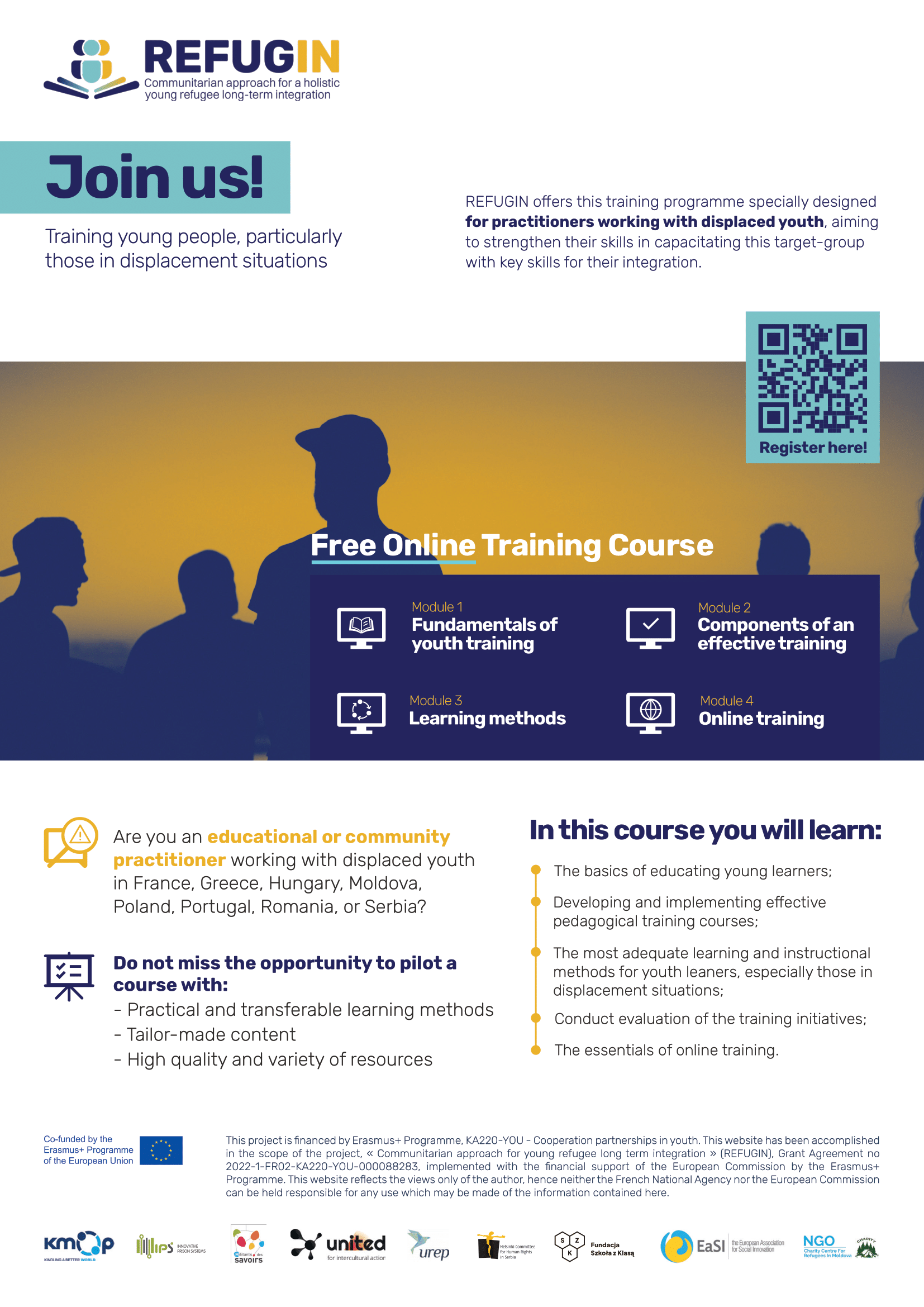
Tailor-made Training courses
Leader : IPS_Innovative Prison Systems

- B-learning training course (public target: civil society professionals) Register here !
- Expert Review Register here !
- E-learning training course (public target: young refugees) Register here !
If you work with youngsters from 14 to 17 years of age in refugee-like situations, you can become their learning mentor and register them here: ➡️ https://lnkd.in/d6euqz9p
🔁 Share this course if you work with or know young individuals in refugee-like situations
Objective
WP4 designed and deployed a comprehensive b-learning training program for education professionals and NGOs, as well as an innovative e-learning course for young refugees.
Three interrelated actions were carried out: an online course with three face-to-face consolidation events (A4.1), a “Train the Trainer” course for dissemination (A4.2), and a tailor-made e-learning course for young people (A4.3).
A total of 540 learners were engaged online, exceeding the initial target, and the face-to-face events reinforced the exchange of practices. The results contribute directly to the project's objectives: skills development for practitioners and capacity building for young refugees .
What has been achieved
A4.1 – B-learning course for practitioners
Pedagogical structure: 3 sequential modules, 7 chapters, 6–8 hours of training, exercises, tests, and surveys.
Localization: content available in English, Greek, French, and Serbian; hosted on the Corrections Learning Academy.
Registration and monitoring system: online form and eligibility check for the target audience; dissemination materials and internal management tools.
Face-to-face anchoring: 3 Knowledge Consolidation Events aligned with the modules to put what has been learned into practice.
Impact: before/after assessment confirming the progress of professionals' knowledge and skills.
A4.2 – Train the Trainer (ToT) course
Architecture: 4 modules, 12 chapters, sequential progression based on the principles of andragogy.
Deployment: first course published on the platform; dedicated dissemination materials and management tools; controlled enrollment.
Spillover effect: trained practitioners are equipped to train their colleagues and peers, removing barriers to training vulnerable audiences ).
A4.3 – E-learning course for young refugees
Joint design (FSZK & IPS): 4 modules, 12 chapters, “hero” narrative to reinforce agency and resolution.
Accessibility: downloadable resources (response to identified lack of digital equipment), translations into Arabic, English, Greek, Polish, and Ukrainian.
Reach and protection: flyers and emails targeting A4.1/A4.2 participants; dual registration system (minors via guardian; adults directly); internal monitoring without identifying data.
Impact: increased capacity of young people to adapt to their new reality.
Who benefited
Young refugees (A4.3): 58 participants
France: 8; Greece: 5; Hungary: 5; Poland: 5; Moldova: 15; Portugal: 6; Serbia: 6; Romania: 8
18 minors registered via responsible guardian
Professionals (A4.1 online): 327 participants
France: 31; Greece: 63; Hungary: 41; Moldova: 31; Poland: 32; Portugal: 38; Romania: 47; Serbia: 44
Professionals (A4.2 – ToT): 155 participants
France: 10; Poland: 10; Greece: 24; Hungary: 13; Moldova: 18; Portugal: 23; Romania: 21; Serbia: 36
Total online (A4.1 + A4.2): 540 participants, exceeding the contractual target of 504; face-to-face events are in addition to this.
Why it matters
Pedagogical quality: structured, sequential, multilingual courses based on andragogy; pre/post assessment demonstrating gains.
Relevance: content and languages aligned with needs identified in advance; downloadable resources to limit the digital divide.
Sustainability: ToT creates a “cascade” effect of dissemination to other professionals; face-to-face events strengthen communities of practice.
Impact: better-trained practitioners, more autonomous young people who are better prepared for educational, social, and professional integration.
Click here to see all the materials training !
Click below to see the reports on results and user feedback
A4.1. Develop a tailored b-Learning training course
B-Learning: Results and Final Report
A4.2. Develop a tailored Train the Trainer course
Final report — Tailored training program for trainers: design, implementation, and evaluation
A4.3. Development of a tailored e- Learning training course for young refugees
Final report - tailored e- Learning training course for young refugees
WP5
Guidelines/Activities to Foster Integration
Leader : Association les Militants des Savoirs (The Conveyors of Knowledge)
- Mentoring scheme
- Framework to guide campaigns (civil society)
- Guidelines for intercultural dialogue (schools)
- Inclusive Disseminationobjective
- To jointly develop, test, and harmonize a European humanistic mentoring model and two operational tools (for NGOs/communities and for schools) in order to measurably strengthen the social and educational integration of young refugees across seven countries.A5.1 – Develop a mentoring program (8 structured sessions)
- What it is. An 8-session program (initial contact, orientation, action plan, skills development, review), with training and support for mentors, and documented longitudinal follow-up.
- How. 36 mentors mobilized, 28 pairs completed the program (82%), standardized tools (ethics charter, questionnaires, reflective journals), mixed analysis (qualitative + comparative statistics by country).
- Measured impact.
- Autonomy & confidence: significant progress for 90% of young people (expression, administrative procedures, initiative).
- Linguistic & social integration: 87% more comfortable with language; 75% increased community participation (integration scores 4–5/5).
- Educational/professional project: 70% formulate a concrete project.
- Sustainability: 70% of pairs continue exchanges after the program.
- Overall quality: rating of 4.55/5 (methodological relevance, educational effectiveness, psychosocial impact).
- What it is. A strategic and operational guide for designing inclusive campaigns and ethical community mobilization, aligned with UNHCR and IOM standards.
- How. Drafting coordinated by CCR, co-constructed by all partners, with structured consultations and peer review to ensure transferability and clarity.
- Expected impact. Professionalizes field practices (ethical communication, public participation, risk management), strengthens the capacities of NGOs, and facilitates the cross-country adoption of replicable actions.
- What it is. A ready-to-use educational reference guide (fundamentals of intercultural education, activity sheets, scenarios) for creating inclusive school environments.
- How. Multi-country co-design, iterative review to ensure consistency, readability, and local adaptation.
- Expected impact. Direct tools for educational teams (diversity management, intercultural dialogue, tension prevention), improved school climate, and educational success for refugee students and their peers.
- See all content hereA5.1. Developing a mentoring programmeMentoring scheme for young refugeesAdditional activities to reuse with young refugeesFinal report-analysis dataA5.2. Designing a framework for intercultural activities in educational and social contextsGuide Promoting Intercultural Dialogue, Tolerance, and Inclusion in SchoolsAdditional activites to reuse with young refugees